Make a Bool That Only Can Be Read C#
Introduction to C Programming
Determination and Branching Concepts
Determination and Branching Concepts
Boolean Variables and Data Blazon ( or lack thereof in C )
- A true boolean data type could be used for storing logical values, and would only have two legal values - "true", and "simulated".
- C does non have boolean information types, and commonly uses integers for boolean testing.
- Cypher is used to represent false, and One is used to represent truthful.
- For interpretation, Nothing is interpreted as false and annihilation not-nix is interpreted as true.
- To brand life easier, C Programmers typically define the terms "truthful" and "false" to have values 1 and 0 respectively.
- In the former days, this was done using #define:
- #define true 1
- #ascertain imitation 0
- Today it is better to use const int instead of #ascertain:
- const int true = i;
- const int simulated = 0;
- C99 provides a new header, stdbool.h, that defines some new helpful types and constants:
- The blazon "bool" is the same equally a newly defined type "_Bool"
- _Bool is an unsigned integer, that tin only be assigned the values 0 or 1
- Attempting to store annihilation else in a _Bool stores a 1. ( Recall that C interprets whatever not-zilch as true, i.east. 1 )
- Variables tin can at present be declared of blazon "bool".
- stdbool.h also defines constants "true" and "false", with value 1 and 0 respectively.
- Use these new features using #include <stdbool.h> at the top of your plan
- The blazon "bool" is the same equally a newly defined type "_Bool"
- In the former days, this was done using #define:
Relational Operators
- Relational operators are binary operators that evaluate the truthhood or falsehood of a relationship between two arguments, and produce a value of true ( 1 ) or false ( 0 ) as a result.
- The post-obit table shows the six relational operators and their meaning, past instance:
| Operator | Meaning |
|---|---|
| A > B | True ( ane ) if A is greater than B, false ( 0 ) otherwise |
| A < B | Truthful ( 1 ) if A is less than B, false ( 0 ) otherwise |
| A >= B | True ( 1 ) if A is greater than or equal to B, false ( 0 ) otherwise |
| A <= B | True ( 1 ) if A is less than or equal to B, false ( 0 ) otherwise |
| A = = B | True ( 1 ) if A is exactly equal to B, false ( 0 ) otherwise |
| A != B | True ( 1 ) if A is non equal to B, faux ( 0 ) otherwise |
- ( Annotation: At that place should not be a space between the two equals signs in = =. I am adding one in these HTML notes so the ii signs do not run together, equally ==. )
- DANGER DANGER: Do non confuse the equality exam operator, = =, with the assignment operator, =. It is a VERY common mistake to use the incorrect number of equals signs, ( either too many or besides few ), and the resulting lawmaking will normally compile and run simply produce incorrect ( and often unpredictable ) results.
- Instance: "while( i = 5 )" is an infinite loop, considering i is given the value 5 by the assignment, and since this is non-zero, it is ever true. The programmer probably meant to use "while( i = = 5 )", which volition test whether or not i is equal to 5, and volition only continue to loop equally long every bit this is true.
- <, <=, >, and >= have equal precedence, college than = = and !=, which have equal precedence with each other. All these operators are evaluated left to right.
- Note: Equally a full general rule, floating indicate numbers ( e.m. floats or doubles ) should NOT be tested for exact equality, considering roundoff makes information technology near incommunicable for two doubles to ever be exactly equal. Instead ane checks to encounter if the 2 numbers are adequate close to each other:
- double x, y, tolerance = 1.0E-half dozen;
- BAD: if( x = = y )
- GOOD: if( fabs( x - y ) < tolerance )
- This is particularly of import when testing the stopping condition of an iterative algorithm, because otherwise the roundoff error could crusade the programme to run forever. WRONG: while( estimatedError != 0.0 )
Logical Operators
- Logical operators are used to combine and evaluate boolean expressions, generally in combination with the relational operators listed to a higher place.
- The following tabular array shows the 3 logical operators and their meaning, by example:
| Operator | Meaning |
|---|---|
| A && B | A AND B - True ( 1 ) if A is true AND B is likewise truthful, false ( 0 ) otherwise |
| A | | B | A OR B - True ( 1 ) if A is true OR B is truthful, false ( 0 ) otherwise |
| ! A | Non A - True ( i ) if A is fake ( 0 ), false ( 0 ) if A is truthful ( non-cypher ). |
- Note: In that location should not be a space between the | characters in | |, but one is being added here for clarity.
- DANGER DANGER: If you only utilise a single & or | instead of the double && or | |, then you go valid code that is beyond the scope of this form, but which will not do what you want.
- ! has a very high precedence, higher than the relational operators listed above. && and | | have lower precedence than the relational operators, with && having higher precedence than | |.
- Instance: To determine whether x is between v.0 and x.0:
- INCORRECT: 5.0 < x < 10.0
- CORRECT: 5.0 < x && x < 10.0
- Question - What is the value of the wrong expression ( regardless of the value of x ), and why?
- Example: Leap year occurs when the current year is divisible past 4, merely NOT when the year is divisible by 100, UNLESS the year is besides divisible by 400.
int year; bool leap_year; leap_year = ( ( ( ( yr % iv ) == 0 ) && ( ( year % 100 ) != 0 ) ) || ( ( year % 400 ) == 0 ) ); // Or equivalently: leap_year = !( year % four ) && year % 100 || !( year % 400 );
- Short Circuiting of Logical Operations:
- In a circuitous logical expression, the computer volition stop evaluating the expression as before long as the result is known.
- "A && B" volition not evaluate B if A is already false.
- "A | | B" will not evaluate B if A is already true.
- Example: "if( 10 != 0.0 && 1.0 / x < 10.0 )" will never carve up by nil.
if-else
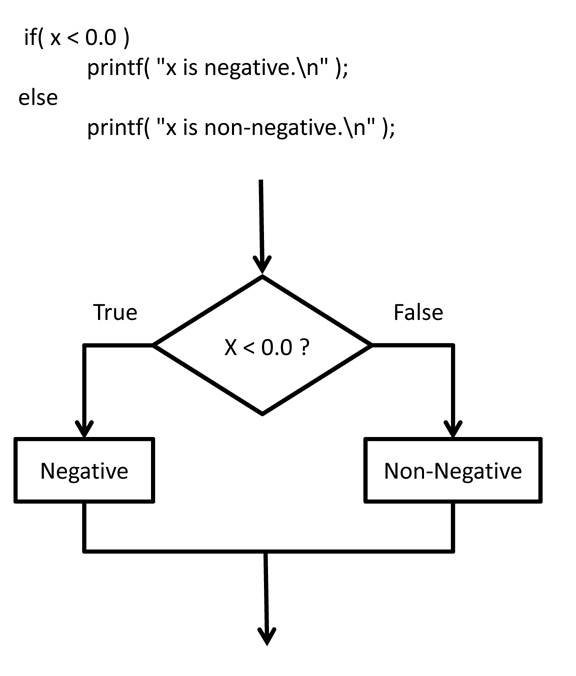
- "if" blocks and "if-else" blocks are used to make decisions, and to optionally execute certain code.
- The full general syntax of the if-else structure is as follows:
if( condition ) true_block else false_block
- Either the true_block or the false_block can be either a single statement or a block of statements enclosed in { curly braces }
- The else clause and the simulated block are optional.
- In execution, the condition is evaluated for truth or falsehood.
- If the status evaluates to true ( non-cypher ), so the true_block of code is executed.
- If the condition evaluates to false ( zero ), then the simulated-block of lawmaking is executed if it is present.
- After 1 or the other cake is executed, so execution continues with whatever code follows the if-else construct, without executing the other block.
- Case:
if( x < 0.0 ) { printf( "Error - The x coordinate cannot be negative. ( 10 = %f ) \northward", x ); exit( -1 ); } - Example:
- Either the true block or the false cake can contain whatsoever other code, including more if-else statements.
- if-else blocks should normally be indented, as shown above. Beware, however, that this is only for the do good of the human, and that the estimator does non pay attention to the indentation. In the post-obit example, for example, the exit( ) call is NOT under the control of the if, and will execute every time:
if( ten < 0.0 ) printf( "Error - The 10 coordinate cannot be negative. ( x = %f ) \northward", x ); exit( -1 );
switch
- In many cases, an integer valued expression must be compared against a number of possible choices, such as the post-obit:
const int left = 1, right = two, up = 3, down = iv; // For improved readability int direction; . . . printf( "Please enter a direction, one for left, 2 for right, ... " ); scanf( "%d", &direction ); if( management = = left ) 10--; else if ( management = = right ) x++; else if ( management = = upwardly ) y++; else if ( direction = = down ) y--; else printf( "Error - Invalid direction entered.\n" );
- In this state of affairs a much improve solution is the switch statement. The equivalent switch for the above is:
const int left = one, right = 2, up = 3, downwards = 4; // For improved readability int direction; . . .
printf( "Delight enter a direction, one for left, 2 for right, ... " ); scanf( "%d", &direction ); switch( direction ) { instance left: x--; break; example right: ten++; interruption; case up: y++; break; case downwardly: y--; break; default: printf( "Error - Invalid direction entered.\n" ); break; } /* Cease of switch on direction */ - The full general syntax for a switch statement is:
switch( variable_integer_expression ) {
case constant_integer_expression_1 :
code block ane;
intermission; // ( Optional - Meet below )
// Repeat the case sub-construct equally many times as needed
default: // Optional
default lawmaking cake;
break; // Not needed. Added for defensive programming only.
} // Terminate of switch on . . .
- The variable expression is compared against each of the abiding expressions one by 1. As presently as a match is found ( equality examination is true ), execution jumps to that location and begins executing the statements found in that location.
- Execution continues until a break argument is encountered.
- If the break statement is omitted from the stop of a instance, then execution will continue into the next case, so on until a interruption is eventually encountered, or until the end of the switch is reached.
- Omitting the break argument is a common mistake.
- Sometimes the pause is omitted intentionally, in guild to combine cases:
bool done = imitation; // Assumes stdbool.h has been #included char choice; while ( ! washed ) { // Lawmaking to print out a menu and ask for choice omitted scanf( "%c", &selection ); switch( choice ) { case 'Eastward': case 'e': /* Lawmaking here to handle Entering data */ break; example 'C': case 'c': /* Code here to handle Calculations */ break; case 'H': case 'h': example '?': /* Lawmaking here to deliver Help */ break; instance 'Q': case 'q': done = true; break; default: printf( "Error - Invalid selection: %c\n", choice ); printf( "Cull 'H' for help.\n"; break; } /* End of switch on menu choices */ } /* End of infinite while loop */ - The default instance is a grab-all, and will be executed if none of the above cases match the variable expression. Although the default case is non required, it is practiced programming practice to always include a default case, in order to take hold of unexpected or even "impossible" situations.
- Where execution speed is critical, the most likely example should be placed first, followed by the next nigh likely, and and so on. Where execution speed is not disquisitional, or where all cases are every bit likely, so cases should be placed in a logical order. There are obvious exceptions to these rules of thumb, such every bit when ane case is designed to fall through to a following case.
- The final case ( or default if present ) does not technically need a "intermission", merely it is good defensive programming to add one anyway, so that it doesn't get overlooked if additional cases become added at a later fourth dimension.
The Provisional Operator
Earlier we looked at unary and binary operators nether C. In addition, the C linguistic communication contains one ternary operator, known as the conditional operator, ?:
- The conditional operator functions very much similar an if-else construct, and the 2 constructs can often be used interchangeably.
- Notwithstanding, due to its operator condition, the results of the conditional operator can as well be used every bit part of a larger expression and/or be assigned to a variable.
- The syntax of the conditional operator is:
status ? true_clause : false_clause
- The condition is first evaluated, ( along with any side effects. ) Then, either the true clause or the false clause will be executed, ( forth with any side effects ), depending on whether the condition evaluates to true ( non-zero ) or simulated ( zero ) respectively. The value of the provisional operator equally used in a larger expression is the value of whichever clause gets executed.
- Examples:
max = i > j ? i : j; abs = x > 0 ? x : -ten; printf(  "X is %s.\northward", ( ten < 0 ? "negative" : "non-negative" ) );
// Parentheses needed in the last instance because + and * college than > and ?: pay = base of operations + ( sales > quota ? ane.five : 1.0 ) * bonus; - Exercises: Implement the following using the conditional operator:
if( error < tolerance ) step *= two.0; else pace = 1.0; if( x != 0.0 ) z /= 10; else z = infinite; if( ten > 0.0 ) sign = i.0; else if ( x = = 0.0 ) sign = 0.0; else sign = -ane.0;
Related Topics
The post-obit topics are non covered hither, but may be found in many books on C/C++;
- Bitwise logical operators, | and &, ^, and ~
- Scrap shift operators, <<, >>
- Combinations of these with consignment, e.chiliad. |=, &=, <<=, >>=, and ^=.
Source: https://www.cs.uic.edu/~jbell/CourseNotes/C_Programming/Decisions.html
0 Response to "Make a Bool That Only Can Be Read C#"
Postar um comentário