Measures of Change in Real Wages and Earnings Monthly Labor Review February 1972
Dear Reader, nosotros make this and other articles available for free online to serve those unable to beget or admission the print edition of Monthly Review. If you lot read the mag online and tin afford a print subscription, we hope you will consider purchasing one. Please visit the MR store for subscription options. Thanks very much.
Form War and Labor'due south Declining Share
Workers in the U.s. are in a very hard situation—one fabricated significantly worse by the Peachy Recession and the very slow "recovery." The latest information as we write this (available for January 2013) indicates that although the unemployment rate has declined from its acme and is now at 7.9 percentage, when those working role time but wanting full-time jobs and those who have given upward looking for work are added in, xiv.4 percent of the labor forcefulness currently needs full-time employment.1 To requite some idea of the meaning of such a big per centum needing full-time jobs, this represents 22 one thousand thousand people, compared to full nonfarm individual-sector employment of about 113 meg. Given the large portion of workers in part-fourth dimension positions, there are currently less than 100 million total-time-equivalent jobs left in the private sector.ii With the public sector hiring few if any workers for the foreseeable future, and no New Deal-type works programme in the cards, the private sector will be the source of whatever job increases occur.
As if the current employment state of affairs is not bad enough, at that place has also been a long-term decline in the relative power of the working class, with capital increasingly gaining the upper hand. 1 crucial indication of this is the stagnation or refuse over decades of existent wages (corrected for inflation). For a while workers' lost ground with respect to wages was compensated for past more than women entering the labor forcefulness so that households increasingly had two earners, helping to maintain household income. However, over the final decade there has even been a downwardly trend in median family income—decreasing from $54,841 in 2000 to $50,054 in 2011 (both in 2011 dollars).3 The fiscal affect of the Bully Recession has had a devastating upshot on many people—with millions declaring bankruptcy, losing homes to foreclosure, or existence forced "underwater" (owing more than than the worth) on their homes.
Although there were numerous other factors at work, President Reagan's 1981 firing of hitting air traffic controllers, replacing them with nonunionized workers, was a turning point in the form war, leading to the decline of workers' power. This action set a tone for private business organisation that made information technology "acceptable" to interruption strikes by bringing in scab labor. Labor legislation protecting workers' right to organize was weakened. The various unanswered attacks on both individual- and public-sector labor that took place helped reverse the by and large favorable view of unions on the part of the public. Consequently, the number of unionized workers has decreased dramatically, with public-sector workers providing now well-nigh of the total matrimony membership, and attacks on unions increasingly focused on the public-sector. Total wedlock membership dropped by 2.8 percent in 2012 to 11.three percent of the workforce, the lowest in the entire mail-2d World State of war catamenia, with more than half the union-membership loss occurring in government jobs. Both the number of strikes and the workdays lost due to strikes have plummeted over the last four decades.4
Amongst the arsenal of tools at capital's disposal that added to the refuse of working-form ability, perhaps the most important was the power of bosses to outsource a portion of the work or actually movement entire factories—first to low-wage parts of the Usa and, more recently, offshoring jobs to Asia and elsewhere to have advantage of low wages and lax environmental laws. Even the mere threat to motility factories and jobs to lower-wage areas has oft been plenty to subdue labor—and understandably and then. With employment growth anemic at best, workers accept been concerned that if they lost their jobs they might non be able to find new ones—or ones as good. In the words of a recent New York Times headline, the "Majority of New Jobs Pay Low Wages."5
Some other long-term trend that has weakened labor has been the increasing employ of part-time employees—anyone working from i to 34 hours per week is officially considered part time. Since the 1970s there has been a general increase in the use of part-fourth dimension labor, which now makes upwardly approximately 20 percent of all employed workers. During the Great Recession when more than eleven million full-fourth dimension jobs were lost, there was really a gain in part timers—so that the reported net loss of jobs, 8.7 million, did not requite a full picture of what was happening.6 Many part-time workers are in especially difficult work environments, with new computerized scheduling programs able to tell bosses the number of workers needed during different days of the calendar week—and even at dissimilar times during the twenty-four hours. As a result, many part-timers, specially in retail sales, do not have fixed schedules that they can count on. This makes it more difficult to work at a second part-time task. An additional problem for labor in the current surroundings is that, of the workers hired during the "recovery" from the Great Recession, over 750,000 of these jobs were supplied by temporary help services, leaving these employees with a precarious concord on their jobs.7
Labor's Share
James G. Galbraith examined the "clasp on wages from the 1950s–1990s," discovering that the wage and salary share of personal income declined every decade on average throughout this period.8 Recently, a number of studies past quite "reputable" sources accept appeared—particularly one by staff at the Cleveland Federal Reserve Depository financial institution and i by the Congressional Upkeep Office—showing the decline in the share of the economic system going to labor seen in the last half of the twentieth century has continued into the present century.9 Using different assumptions and approaches they developed three different calculations, all of which indicated that labor'south share has been failing for some time.
Determining labor's share of the pie obviously raises a number of methodological questions, as there are various ways to calculate this. Labor'due south share of income can be estimated on the basis of either (a) wages and salaries received by workers or (b) total compensation. The latter includes, in add-on to wages and salaries, benefits provided by employers—both legally required insurance entitling the employee to benefits in the result of ill-wellness, unemployment, inability, and old-age retirement, and also voluntary benefits such as paid leave and life insurance. These benefits differ considerably. Some, such as Social Security and Medicare, are genuine social insurance programs. Others, such as the Health Management Organizations (HMOs) in which workers are enrolled by their employers, are private insurance programs, where workers are required to pay a large and increasing portion of the toll, generating high profits to insurance companies and offering diminishing use-value per benefit dollar to employees.10
It is important to recognize that benefits received past employees—distinguishing total compensation from mere wages and salaries—are very unevenly divided in the U.Southward. economic system. They vary past (a) whether the worker is full time or part fourth dimension—benefits represent 31 percent of full compensation for individual sector full-time workers but only 21 percentage for role-fourth dimension employees; (b) union or nonunion—benefits are approximately 41 percent of all compensation for unionized goods-producing employees versus 31 percent for nonunion employees doing similar jobs; and (c) job type—for instance, benefits represent 34 pct of total bounty for full-time "information" employees versus 29 percent for full-fourth dimension service employees.eleven
Depending on the nature of the question, then, i may wish to emphasize either total compensation or wages and salaries in analyzing labor's share, comparing them alternately to Gross domestic product (or some other national-income indicator) or to private-sector output. In all cases, yet, the full general trends are very similar. Movements of full compensation and wages and salaries generally rise and fall together. This means, according to The State of Working America for 2012, "that analyses…that focus on wage trends" alone equally opposed to total compensation "are using an appropriate proxy for compensation, at least on average."12
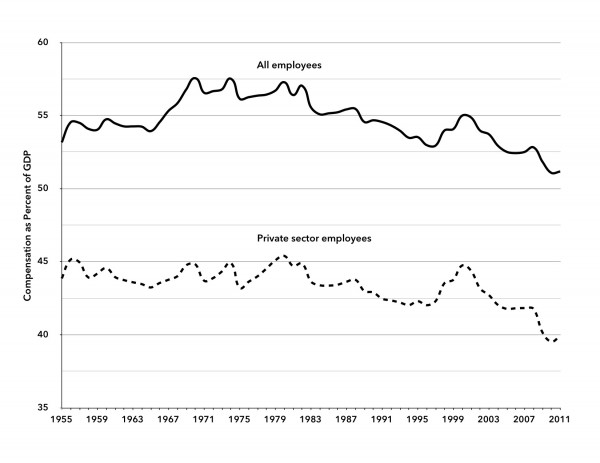
Here, we shall expect separately at the shares of GDP represented by total compensation and wages and salaries. The upper line in Chart one shows the total bounty of all employees receiving wages and salaries—workers and managers in the government and individual sectors—as a percent of Gdp, while the lower line is restricted to full compensation of individual-sector employees as a percent of GDP. Comparing the 2 lines, we can see that after a brief ascent in the late 1960s a plateau emerges in the labor share of Gross domestic product for all employees (upper line), persisting through much of the 1970s, followed past a downward trend to the nowadays. In dissimilarity, the labor share of GDP for private sector employees alone (lower line) exhibits no increase in the 1960s, and a decline from the 1980s to the present. The slight rise in the labor share for all employees in the late 1960s along with the plateau for much of the '70s can therefore be attributed almost entirely to the increase in authorities and non-profit-sector employment in these years. This corresponded to the Vietnam War, the Great Guild, and the Nixon Family Assistance Plan, and to state and local government hiring to staff new schools and expand constabulary and fire departments in the burgeoning suburbs. In the 2d half of 1966, during the big buildup of the Vietnam War, military expenditures accounted for one-half of the total increase in Gross domestic product.13 Overall, there was a huge increment in civilian government employees—federal, state, and local—in this menses with civilian regime employment as a percentage of all nonfarm employment rise from fifteen.6 percent in 1960 to its post-2d World War summit of 19.2 percent in 1975.14
Chart 1. Full Labor Compensation as a Per centum of Gdp
Sources: "All employees" is authorities and non-turn a profit-sector employees plus private-sector employees (excluding non-profit employees hither from the private sector). Compensation for authorities employees from Table 1.13, "National Income by Sector, Legal Grade of Organization, and Type of Income," National Income and Product Accounts (NIPA), Bureau of Economic Assay (BEA); Compensation for private sector employees, is from unpublished Bureau of Labor Statistics (BLS) data; "Gross domestic product" (GDP), St. Louis Federal Reserve (FRED Database), http://enquiry.stlouisfed.org/fred2. BLS data for private sector compensation provided past personal communication from the Supervisory Economist, Role of Productivity and Engineering science Segmentation of Major Sector Productivity.
Non surprisingly, this period was one of relative prosperity for workers. The average rate of real growth of the U.South. economic system was higher in the 1950s and '60s than in the '70s. Simply even in the 1970s the economic growth charge per unit exceeded that of the three decades that were to follow.fifteen
Chart 1 shows that total compensation of both all employees and private sector employees as a percentage of Gdp continued a downward slide for well-nigh of the 1980s, '90s, and the start decade of this century. Nonetheless, a brief crash-land upwards was experienced in the second half of the 1990s. The temporary ascension in the compensation share at that time was mainly a product of the dot-com financial boom, which turned into a bust in 2000. The bursting of the dot-com bubble led to a sudden drop in the compensation share, which was given an added downwardly button by the Great Recession less than a decade later.
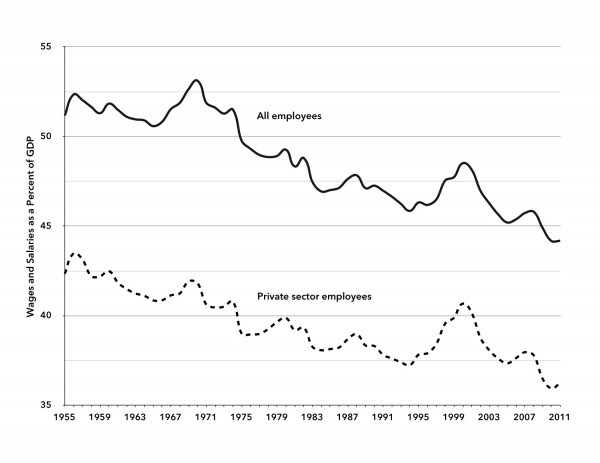
Wages and salaries, every bit singled-out from full compensation, are particularly important for workers at the lower-income levels, since this is the basis of their everyday consumption, constituting their means of subsistence. As with total bounty—only more so—wages and salaries exhibited a strong downward trend every bit a per centum of national output of goods and services (Nautical chart 2). Similar to what we observed in the instance of the total-compensation share, a brief, cyclical increase in the wage share is evident for all employees in the late 1960s and early '70s (upper line). Merely but as we saw with respect to full bounty, this short-term increment in the wage share disappears once nosotros look at the wages and salaries of private-sector employees as a percentage of GDP (lower line). Hence, the rising wage share for all employees in these years is once once more explained primarily past the expansion of government and non-profit-sector employment, and later eroded along with the pass up of regime consumption and investment as a percent of Gdp starting time in the 1970s.sixteen It was non until the late 1990s dot-com bubble that one again sees significant employment gains, too equally small increases in wages and salaries, resulting in a very brief increment in the share of wages and salaries in GDP—though never approaching its previous peaks, and plummeting thereafter.
Nautical chart 2. Wages and Salaries as a Percent of GDP
Sources: Salary and wages for all employees and individual sector employees from Table ane.12, NIPA, BEA; GDP, FRED Database.
Overall the decline in existent wages (corrected for aggrandizement) since the 1970s has been sharp. As David Gordon observed in 1996 in Fatty and Mean, by the early on 1990s the real hourly spendable earnings of individual nonproduction/nonsupervisory employees in the Usa had fallen "below the level they had last reached in 1967… . Referring to these trends since the early on 1970s as 'the wage squeeze' is polite understatement. Calling it the 'wage collapse' might be more apt."17 While the existent hourly wage for all nonfarm private workers has declined, weekly (or annual) wages and salaries have fallen fifty-fifty faster. In the early 1970s the average earnings of nonfarm private workers was over $340 per week (in 1982–1984 dollars). Earnings of these workers declined speedily to less than $270 per calendar week in the early on 1990s, rebounding to $294 per week by 2011—still shut to 15 pct less than in 1973.eighteen The decline in real income per week was the product of two trends: (1) stagnating and declining real hourly wages and (2) the pass up of hours worked per calendar week. As more people worked part time, the average hours worked in private sector nonfarm jobs declined from 38.vi hours in 1965 to 33.6 hours in 2011.19 It was this combination of declining real wages and fewer hours worked that left workers poorer and in more than precarious positions.
A Expect at Grade Divisions and Wages
The labor share of income as depicted above in terms of both total employee bounty and wages and salaries as shares of Gdp is of course a very crude indicator of what is happening to the working-grade income, downplaying the actual fall in working-class wages and salaries as a share of GDP. This is considering the amass data also includes the bounty going to CEOs and other upper-level management, which ought to be counted as income to capital rather than labor. The wages and salaries (and benefits) of higher direction positions have been ascent in leaps and bounds in recent decades while workers' wages at the bottom accept lost basis. Consequently, the actual decline in wages as a share of Gdp is much sharper where the working form itself is concerned. An test of real hourly wages 1979–2011 by income decile (upward to the 95th percentile) shows that the existent hourly wage of the lesser decile shrank in accented terms over the menstruation, while that of the top decile increased by more than 35 per centum.xx Thus, although the wage share of income has sharply dropped in the U.S. economic system, this pass up has not been shared equally, and applies mainly to what is properly called the working class, i.e., the bottom 80 percentage or so of wage and salary workers.
We should add together, parenthetically, that the term "working course" is inappreciably used in the dominant discourse in the United states today. Many workers conceive of themselves as part of the "middle class" because they have come to call back of their income as providing them with a "eye-grade lifestyle"—and because they consider themselves above "the poor," who take been converted in the ruling ideology into the entire lower class (or underclass), leaving out the working class altogether. Nevertheless, from a perspective that focuses on class as a power relation the working class rightly includes all those who piece of work for wages or salaries and are not in a management or predominantly supervisory position—and who are also not loftier-level professionals, such as doctors, lawyers, and accountants. Some members of the working class might be paid very well, but they still have the same bones relationship of worker to capital or "the dominate."21
There is no routine collection of statistics on the entire working class. The closest that the official statistics come to in this respect is in the standard private-sector reporting category called "production and nonsupervisory" workers, which includes "production workers in the goods-producing industries and nonsupervisory workers in the service-providing industries." Although comprising some ninety million employees (about eighty percentage of private-sector workers), it is a very rough approximation of the U.S. working class, leaving out many who should exist counted.22 The residuum group of private-sector employees not considered in this category, which we refer to in this article as "management, supervisory, and other nonproduction employees," undoubtedly includes many employees who might well be considered part of the working grade. Moreover, the production and nonsupervisory workers category applies only to the private sector and thus leaves out all government workers, many of whom, such every bit those who work in the post office, public schools, and local law, should be included within the total working form. So while the data tells us a lot, we must recognize its inadequacies. Still, it is the best statistical basis available for looking at the working grade as a whole, every bit inadequate as it may exist.
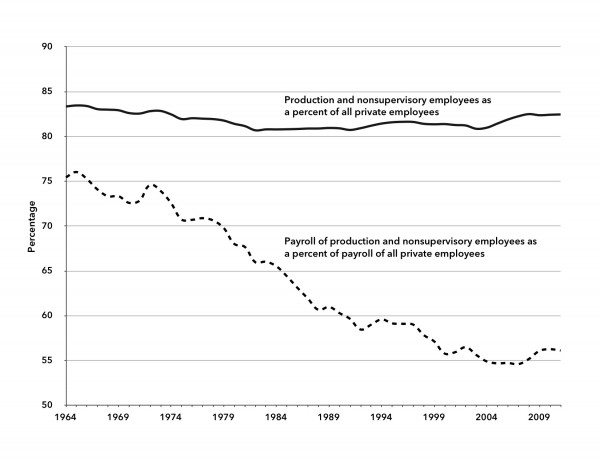
Chart 3 provides information related to production and nonsupervisory employees. While the share of the GDP going to the wages and salaries of all individual employees has, as nosotros take seen, decreased dramatically (lower line in chart 2), the drib in the wage income of production and nonsupervisory workers as depicted here has been even more startling. Chart 3 shows that private-sector production and nonsupervisory workers take remained a fairly constant per centum of all private employment from the mid–1960s to the present. (Meet the superlative line in the chart, indicating that these workers represented around 83 per centum of all private sector workers in both 1965 and 2011.) However, the share of production and nonsupervisory workers in the total private sector payroll dropped from over 75 percent in 1965 to less than 55 percentage during the Great Recession, and has only risen slightly since.
Chart 3. Number and Payroll of Product and Nonsupervisory Employees every bit a Percentage of Total Private Sector
Sources: Number of private sector production and nonsupervisory employees from BLS Series CES0500000006; Total private sector employees from "All Employees: Total Private Industries" (USPRIV), FRED database; Annual payroll of production and nonsupervisory is calculated from weekly aggregate payroll, BLS Series CES0500000082; Aggregate payroll of all individual employees from Table ane.12, NIPA, BEA.
The implication of this, of course, is that the direction, supervisory and other nonproduction employees at the top, representing around 17 percent of individual employees, receive more than than 40 percent of private sector wage and bacon income—and this share is rising.
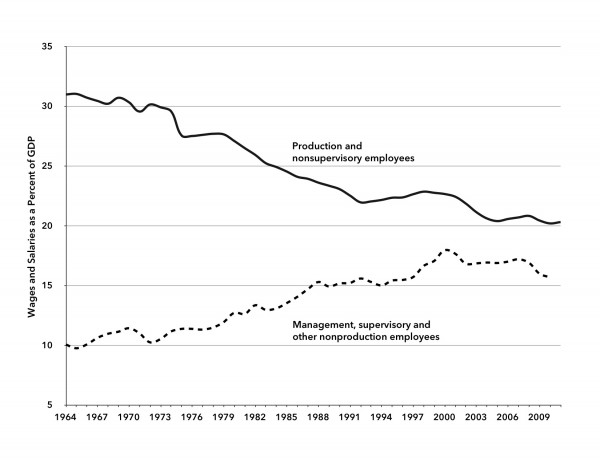
We see the contrasts even more clearly when we look in Chart 4 at the shares of Gross domestic product going to the two separate groups that make upward private employees—production and nonsupervisory employees versus what we accept labeled as management, supervisory, and other nonproduction employees. Wages and salaries received past the upper levels of private employees actually increased from 1965 to the present every bit a share of GDP. At the same fourth dimension, those of the over 80 percentage of private-sector workers in the production and nonsupervisory worker category saw their wages and salaries turn down dramatically, from over 30 percent of the GDP to about 20 percent in 2011. Hence, the rapidly declining wage share in the monopoly-finance-capital letter flow since the mid–1970s stagflation crisis vicious entirely on the backs of working-form employees.
Chart 4. Wages and Salaries of Private Sector Employees every bit a Pct of GDP
Sources: Same as Nautical chart three, with share of GDP to "Management, supervisory and other nonproductive employees" calculated by subtraction of wages and salaries of "production and nonsupervisory employees" from wages and salaries of all private sector employees.
Given this groundwork of loftier unemployment, lower-wage jobs, and smaller portions of the pie going to workers, it should come up as no surprise that, according to the U.S. Census Bureau, about 50 1000000 people in the United States alive in poverty (with income in 2011 beneath $23,021 for a family unit of four) while some other fifty million live between the poverty level and twice the poverty level—i paycheck abroad from economic disaster.23 Thus, the poor (those in poverty or near poverty), most of whom vest to the working poor, account for approximately 100 million people, fully i-third of the entire U.Due south. population.
Writing more than than a decade ago, Bill Moyers commented on the plight of labor equally follows: "Our business and political class owes us better than this. Afterward all, information technology was they who declared class war 20 years agone, and it was they who won. They're on tiptop."24 Yet, the way the organization works, the ruling class does non owe workers anything aside from wages and bacon earned and legally required benefits. And the attack on labor—its unions, wages, working conditions, social programs, and even legally required benefits—continues to this day.
Wage repression and high unemployment are the dominant realities of our time. A vast redistribution of income—Robin Hood in reverse—is occurring that is boosting the share of income to capital, even in a stagnating economic system. Is it any wonder, and then, that for years on end polls have shown a majority of the population like-minded with the statement that the Us is on the wrong track and not headed in the right direction?25
Notes
- ↩ U.S. Agency of Labor Statistics, Economic News Release, Culling Measures of Labor Utilization, Table A-15, http://bls.gov.
- ↩ 90-six million full fourth dimension equivalent private sector workers calculated assuming a forty hour work week and using actual hours worked per week from Average Weekly Hours Of All Employees: Total Private (AWHAETP) and number of individual employees from All Employees: Full Private Industries (USPRIV), from St. Louis Federal Reserve FRED database, http://research.stlouisfed.org/fred2/, Dec thirty, 2012.
- ↩ U.Due south. Census Bureau, Historical Income Tables: Households, Table H-6. Regions—All Races by Median and Mean, http://census.gov.
- ↩ Melanie Trottman and Kris Maher, "Organized Labor Loses Members," Wall Street Journal, January 23, 2013, http://online.wsj.com.
- ↩ Catherine Rampell, "Majority of New Jobs Pay Low Wages, Written report Finds," New York Times, August xxx, 2012, http://nytimes.com.
- ↩ St. Louis Federal Reserve, FRED database, Employed, Usually Work Part Time (LNS12600000), Jan 4, 2013, http://research.stlouisfed.org.
- ↩ Bureau of Labor Statistics database, Employment, Hours, and Earnings from the Electric current Employment Statistics survey (National), Employees Temporary Help Services (series ID CES6056132001), http://data.bls.gov.
- ↩ James Chiliad. Galbraith, Created Unequal (New York: The Complimentary Press, 1998), 82–83.
- ↩ Margaret Jacobson and Filippo Occhino, "Backside the Decline in Labor's Share of Income," Cleveland Federal Reserve, 2012, http://clevelandfed.org; Congressional Upkeep Office, What Accounts for the Slow Growth of the Economy After the Recession? (see Effigy 7, p. 14), 2012, http://cbo.gov. Galbraith's data here shows that directly income to capital letter in the form of involvement, dividends, and rent increased from x per centum of personal income in the 1940s to 17 percentage in the 1990s.
- ↩ Data on total compensation also includes "other compensation" such as bonuses and stock options mainly applying to upper-level direction. It does non, however, include capital gains which are the main source of the increasing wealth of the capitalist class.
- ↩ Bureau of Labor Statistics, U.Due south. Department of Labor, "Employer Costs for Employee Compensation" database, http://bls.gov.
- ↩Economic Policy Plant, The State of Working America, 12th edition (Ithaca, NY: Cornell University Printing, 2012), 182.
- ↩ Michał Kalecki, The Final Phase of Commercialism (New York: Monthly Review Press, 1971), 110.
- ↩ Agency of Labor Statistics, Current Employment Statistics Survey, http://bls.gov.
- ↩ John Bellamy Foster and Fred Magdoff, Bang-up Financial Crisis (New York: Monthly Review Press, 2012), 129.
- ↩ On government spending (government consumption and investment) as a percent of GDP over the post-2nd Globe State of war period, see John Bellamy Foster and Robert W. McChesney, "A New New Deal Nether Obama? ," Monthly Review 60, no. 9 (February 2009): 4–v.
- ↩ David M. Gordon, Fat and Mean (New York; Free Press, 1996), 19–20.
- ↩ Calculated from Table B-47 of the 2012 Economical Report of the President, http://gpo.gov.
- ↩ Tabular array B-47, Hours and earnings in private nonagricultural industries, 1965–2011, 2012 Economical Report of the President, http://gpo.gov.
- ↩ Economic Policy Institute, The State of Working America, 12th edition, 186. The information goes up to the ninety-fifth percentile and does not include the income of the superlative v percent of the population.
- ↩ See Michael Zweig, "Six Points on Class," in Michael Yates, ed., More Unequal (New York: Monthly Review Printing, 2007), 173–82. In a larger sense the working class also can exist seen as including many of those on public help and who accept retired every bit well, along with dependents. Merely we are dealing here merely with the working class as a component of the officially designated labor force.
- ↩ From St. Louis Federal Reserve FRED database, Production and Nonsupervisory Employees: Total Private (CES0500000006), updated January 1, 2013, http://research.stlouisfed.org.
- ↩ Carmen DeNavas-Walt, Bernadette D. Proctor, Jessica C. Smith, Income, Poverty, and Health Insurance Coverage in the U.s.a.: 2011, United States Census Agency, 2012, http://demography.gov.
- ↩ Bill Moyers, "Which America Will We Be At present?," The Nation 271, no. 16 (November nineteen, 2001): 11–14.
- ↩ "Right Direction or Incorrect Runway: 35% Say U.S. Heading in the Right Direction," Rasmussen Reports, Jan 23, 2013, http://rasmussenreports.com.
Source: https://monthlyreview.org/2013/03/01/class-war-and-labors-declining-share/
0 Response to "Measures of Change in Real Wages and Earnings Monthly Labor Review February 1972"
Postar um comentário